

 Something else? Ask Aunt Vadge – bottom left of your screen!

Obtaining genuine, high-quality extra virgin olive oil can be tricky, with many suppliers blending olive oil with other types of oil, due to crop shortages.
Finding authentic olive oil rich in polyphenols, the compounds behind its antimicrobial and anti-inflammatory activity, is easy if you know what to look for. Here’s a quick explainer to help you choose the best, most therapeutically active olive oil.
Benefits of extra virgin olive oil
Extra virgin olive oil is antimicrobial and anti-inflammatory. Most of these therapeutic powers come from its high levels of polyphenols.1,2 Refining olive oil strips the polyphenols out, so cheaper “light” and refined oils don’t have much. Take two tablespoons daily with food (salad dressing, dipping) or straight off the spoon.
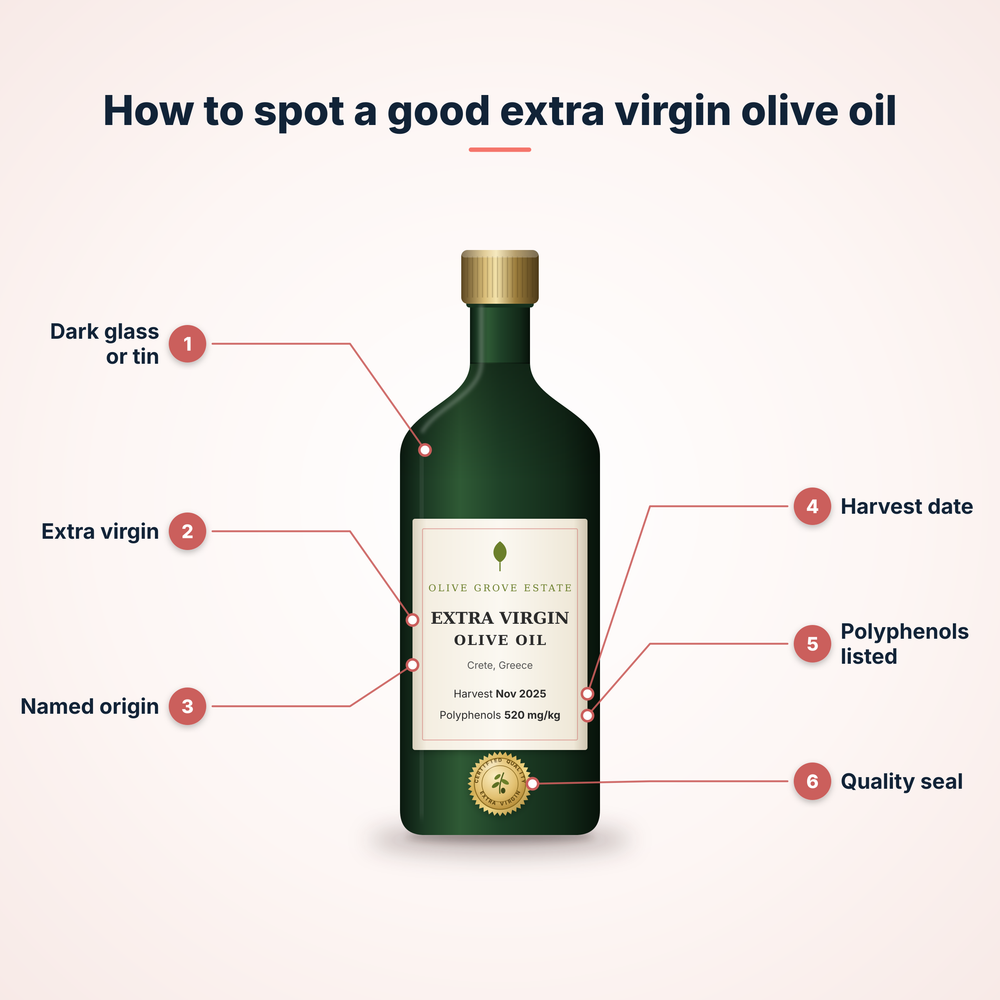
Choose a reputable brand, as sadly not all olive oil is actually 100 per cent olive oil anymore. Look for a dark glass bottle, third-party testing seals and a harvest date.
Look for
- Extra virgin olive oil (EVOO), not “light”, “pure” or plain “olive oil”
- A certification seal from your region (see below)
- Dark glass or tin packaging, to keep out light
- Bottles stored somewhere cool, not in a sunny shop window
- A harvest date within the last 12–18 months
- A stated polyphenol content, if the producer lists it
- Ideally, a specialty shop, farmers’ market or direct from the producer
Check the label for key information
- “First cold pressed” or “cold extraction” – in the EU, this means the oil was kept below 27 °C during processing.3 All extra virgin olive oil is made without chemicals, so it’s not a big selling point.
- Specific origin – the best oils name the estate or region. “Product of the EU” or “blend of EU and non-EU oils” means oil from several countries, so you can’t tell how fresh it is.
- “Extra virgin” – free acidity of 0.8 per cent or less, no off smells or flavours, and a fresh, fruity taste.4
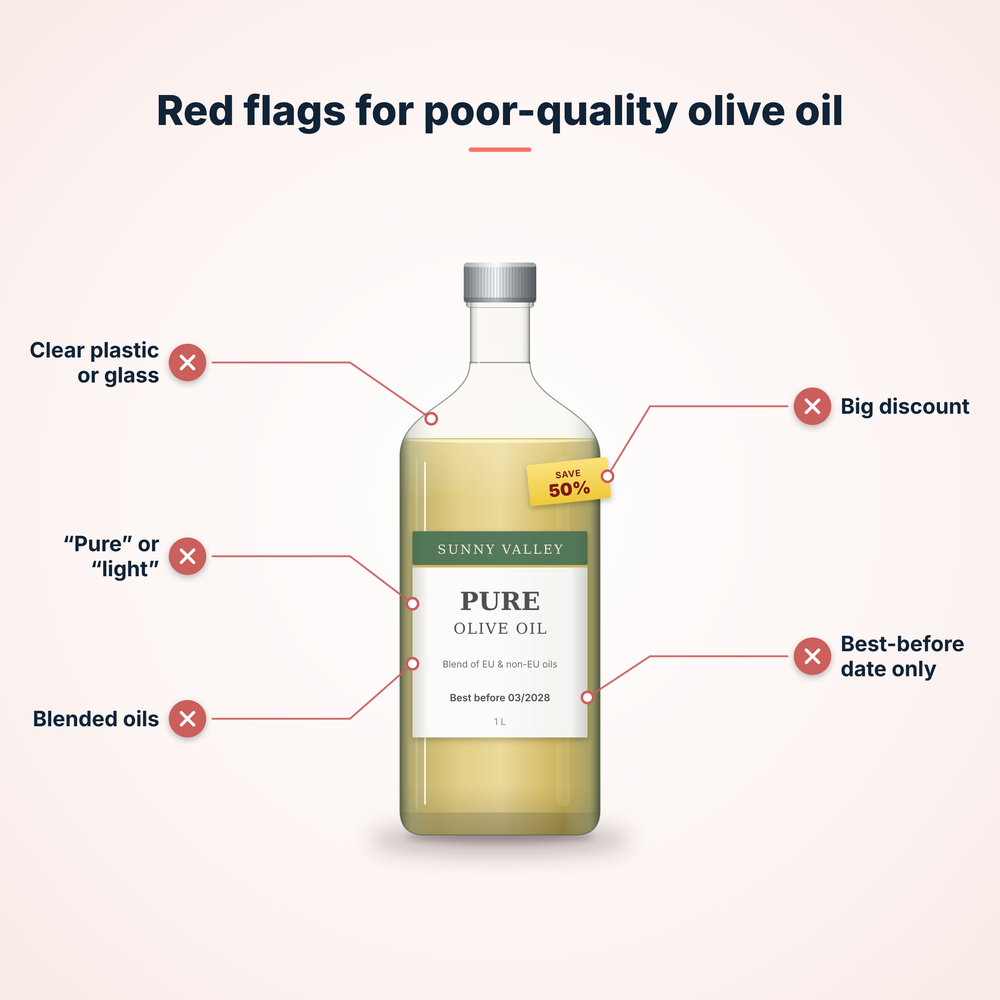
Avoid these red flags
- Clear bottles – light breaks down the oil and its polyphenols.
- Plastic bottles – air gets through plastic, so the oil goes stale faster.
- Only a best-before date, or no date at all – you can’t tell when the olives were picked.
Use your senses (if tasting is an option)
A good extra virgin olive oil should be:
- Fresh-smelling – fruity, grassy or green. Rancid oil smells like crayons, putty or stale nuts, and musty oil smells mouldy.
- Bitter and peppery – these flavours come from the polyphenols.
- A bit harsh on the throat – a catch or cough at the back of your throat is a good sign. It comes from oleocanthal, the polyphenol that acts a little like ibuprofen.2
Buy from reputable sources
Be wary of big-brand olive oils sold at a deep discount in supermarkets. A price that seems too good to be true is a warning sign. Good olive oil is not cheap.
Look for certification seals
A seal means the oil has been independently checked. Look for the one used where you live:
- Australia – the OliveCare triangle on Australian-grown oils. Imported oils may carry the Australian Olive Oil Association’s Certified Quality Seal.
- New Zealand – OliveMark, from Olives New Zealand.
- USA and Canada – NAOOA Certified (North American Olive Oil Association), found on many US brands and now expanding into Canada. Oils made from California olives may carry the COOC seal (California Olive Oil Council).
- UK and Europe – PDO (Protected Designation of Origin) or PGI (Protected Geographical Indication). Some labels use the local name instead: DOP in Italy, Spain and Portugal, AOP in France, ΠΟΠ in Greece.
Seals confirm the oil is genuine, but they don’t measure polyphenols. Check the label for a polyphenol figure as well.
What “extra virgin” actually means
Among other checks, international standards require:4
Free acidity of 0.8 per cent or less
This measures how much the oil has broken down. A low number means healthy olives, pressed soon after picking.
No taste or smell defects
A trained tasting panel must find no faults (like rancid, musty or fusty) and at least some fresh, fruity flavour.
Find certified oils
- Australia – OliveCare (Australian Olive Association) and Australian Olive Oil Association Certified Quality Seal
- New Zealand – OliveMark certified oils (Olives New Zealand)
- USA and Canada – NAOOA certified olive oil list and California Olive Oil Council seal program
- UK and Europe – EU register of protected food names (eAmbrosia) and UK register of protected food names
This is general information based on current research and our clinical experience, not a substitute for personalised medical advice.
- Medina E, de Castro A, Romero C, Brenes M. Comparison of the concentrations of phenolic compounds in olive oils and other plant oils: correlation with antimicrobial activity. J Agric Food Chem. 2006;54(14):4954–4961.
- Beauchamp GK, Keast RSJ, Morel D, Lin J, Pika J, Han Q, Lee CH, Smith AB, Breslin PAS. Phytochemistry: ibuprofen-like activity in extra-virgin olive oil. Nature. 2005;437(7055):45–46.
- European Commission. Commission Delegated Regulation (EU) 2022/2104 of 29 July 2022 supplementing Regulation (EU) No 1308/2013 of the European Parliament and of the Council as regards marketing standards for olive oil, and repealing Commission Regulation (EEC) No 2568/91 and Commission Implementing Regulation (EU) No 29/2012. Official Journal of the European Union. 2022. Article 10.
- International Olive Council. Trade standard applying to olive oils and olive pomace oils. COI/T.15/NC No. 3/Rev. 22. Madrid: IOC; 2026.