

 Something else? Ask Aunt Vadge – bottom left of your screen!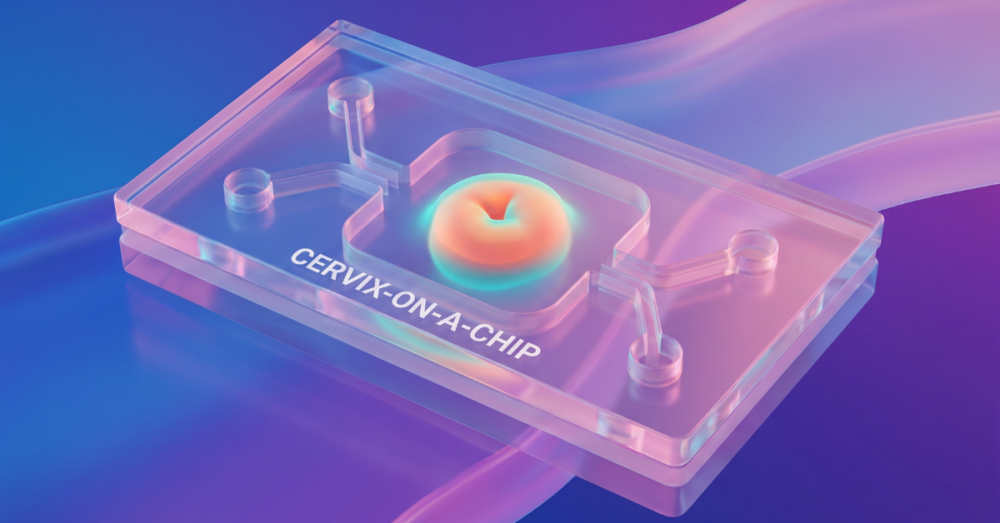

For the first time, scientists have created a functioning ‘cervix-on-a-chip’ – a miniaturised, laboratory-grown model of the human cervix that includes immune cells – allowing them to study how the vaginal microbiome, immune system, and sexually transmitted infections (STIs) interact.
The results confirm what many researchers have long suspected: protective bacteria, particularly Lactobacillus crispatus, significantly limit STI infection risk.1
The breakthrough comes from a team at the University of Maryland School of Medicine, with first author Katherine Nelson and senior author Jacques Ravel, published in Science Advances in April 2026.1 For the first time, we can watch these interactions happen in real time in a system that closely mimics the human body.
In our clinical work, we see how a depleted, lactobacillus-poor microbiome travels alongside recurrent infections, and this model helps explain the mechanism behind what we observe.
What is a cervix-on-a-chip and why does it matter?
An ‘organ-on-a-chip’ is a tiny, engineered model of human tissue – in this case the cervix – grown in a laboratory. It’s thinner than a human hair and built from real human cells arranged in layers to recreate the structure and function of the actual tissue.
Previous cervical models were limited. They either lacked immune cells or didn’t include the vaginal microbiome. The new model is the first to include all three essential elements – epithelial cells (the lining), immune cells, and real bacterial microbiota – making it far more realistic. This means researchers can finally observe the complex conversations between immune cells, protective bacteria, pathogens, and the cervical lining.
This is important because traditional study methods – cell cultures in a dish or animal models – are too simplistic to capture what actually happens in the human vagina. Organ-on-chip technology changes that. It lets scientists test new treatments, study disease mechanisms, and predict which therapies will work, all without waiting for human trials.
What did the researchers find about microbiome and STI protection?
The team seeded the cervix-on-a-chip with different vaginal microbiota types and then exposed them to STI pathogens, including Chlamydia trachomatis and Neisseria gonorrhoeae. The findings were striking:
- L. crispatus-dominated microbiomes (the ‘optimal’ or ‘protective’ type, commonly labelled Community State Type I, or CST-I) limited infection
- ‘Nonoptimal’ microbiomes (those lacking protective lactobacilli or dominated by disruptive bacteria like Gardnerella vaginalis) showed significantly worse infection outcomes
- The immune system’s response was different depending on the microbiota present – protective bacteria triggered a ‘smarter’ immune response that contained infection without excessive inflammation
In other words, the cervix-on-a-chip confirmed in real time what epidemiological studies have suggested for years: the quality of your vaginal microbiome directly affects your vulnerability to STIs.2 A Lactobacillus crispatus-dominated microbiome isn’t just ‘less bad’ – it actively protects you. And when it’s absent, your risk climbs steeply.
The protective effect appears to work through multiple mechanisms. Lactobacillus crispatus produces lactic acid, which creates an acidic environment (around pH 3.8–4.5) hostile to many STI pathogens.3 But the immune cells also matter. When protective bacteria are present, the immune system responds more effectively and with less tissue damage. When they’re absent, the immune response is disorganised and potentially harmful.
What the vaginal microbiome and STIs research shows
The chip results line up with what large studies in real women already show. In a lactobacillus-depleted state such as bacterial vaginosis, the odds of testing positive for an STI climb sharply: women with BV were around four times more likely to have gonorrhoea and 3.4 times more likely to have chlamydia than women with a lactobacillus-dominant microbiome.4 The loss of lactic acid, a higher vaginal pH, and increased inflammation are thought to be the main drivers.5
It’s a link we see play out in the clinic, where recurrent BV and a heavier infection burden so often go hand in hand.
What does this mean for you?
This research has several practical implications. First, it gives us a powerful tool to test new treatments – probiotics, live biotherapeutics, antimicrobials – before they reach human trials. Second, it confirms the clinical importance of maintaining a Lactobacillus crispatus-dominant microbiome for STI prevention. Third, it shows that STI risk isn’t just about exposure. It’s also about the state of your microbiome.
If you have a Lactobacillus crispatus-dominant microbiome, this research underscores the importance of protecting it – avoiding douches, harsh cleansers, and unnecessary antibiotics.
If you don’t have this protective microbiome, the research suggests that restoring protective bacteria might be worth exploring, whether through probiotics, live biotherapeutics, or by addressing the factors that disrupted your microbiome in the first place (sexual behaviour, partner microbiota, antibiotic use, hormonal changes).
The research also opens new doors for personalised medicine. In the future, your microbiome test results might help predict your actual STI risk and guide targeted prevention strategies.
What’s next for the cervix-on-a-chip?
The research team plans to use the model to test new treatments and study other vaginal and reproductive health conditions. The model can be adapted to study different microbiota profiles, hormonal states (mimicking the menstrual cycle), and responses to vaccines or antivirals. It’s a significant step forward for the field.
FAQ
Does a healthy vaginal microbiome protect against chlamydia and gonorrhoea?
In this model, a microbiome dominated by protective Lactobacillus crispatus limited infection by both Chlamydia trachomatis and Neisseria gonorrhoeae, the two most common bacterial STIs.1 It is meaningful protection, not a guarantee – barrier methods and regular STI testing still matter.
Why does low lactobacillus increase STI risk?
When protective lactobacilli are depleted, the vagina loses the acidic, lactic-acid-rich environment that holds many pathogens back. And the immune response becomes more disorganised and inflammatory.2 Both changes make it easier for an STI to take hold.
Does this mean I should take a probiotic?
Not necessarily. We only know that L. crispatus is protective. But it’s not the only microbiome player that can be healthy for you. There are microbiome profiles that are more or less protective, but there is no one size fits all.
A microbiome that doesn’t cause problems for you, your partner or any potential pregnancies is a good enough microbiome.
If you already have a Lactobacillus crispatus-dominant microbiome (check with a microbiome test), focus on protecting it with a healthy body and protect yourself during sex.
If you don’t, or if you’re prone to recurrent infections such as bacterial vaginosis (BV), it’s worth exploring your protective options with your healthcare provider. Some people benefit from targeted probiotics. Others may need to address underlying causes (like sexual practices or partner factors).
Can I test my microbiome type?
Yes. Several laboratories offer microbiome testing, including Juno Bio, MicroGen DX, and Evvy. These tests use genetic sequencing to identify your microbiota composition and tell you which community state type you are, such as CST-I (L. crispatus-dominated), CST-II (L. gasseri-dominated), CST-III (L. iners-dominated), CST-IV (mixed, lactobacillus-depleted), or other types.6
How is this different from previous microbiome research?
Earlier studies used animal models or simplified cell cultures, neither of which included a realistic immune system or full microbiota. This cervix-on-a-chip is the first to combine all three in a working system, allowing researchers to see the immune-microbiota-pathogen interaction in action.
Does a Lactobacillus crispatus microbiome guarantee I won’t get an STI?
No. A protective microbiome significantly reduces risk. But it doesn’t eliminate it. Other factors matter too: exposure, condom use, partner status, and immune function all play a role. Think of it as an important layer of protection, not an absolute shield.
Can I change my microbiome type?
Yes, though it can take time. Probiotics, live biotherapeutics, lifestyle changes (using protection during sex while undergoing treatment, using condoms), and treating underlying dysbiosis can all help shift the balance towards Lactobacillus crispatus dominance. Some people shift naturally; others need targeted support.
Is this technology being used clinically yet?
Not for patient diagnosis. The cervix-on-a-chip is a research tool, used primarily to test treatments and understand disease mechanisms. It will likely feed into clinical practice over the next 5–10 years through faster drug development and better-informed prevention strategies.
What about HPV and cervical cancer risk?
The team used this model to study bacterial STIs (chlamydia and gonorrhoea), but similar technology could be applied to human papillomavirus (HPV). Some researchers have already suggested that microbiome composition influences HPV persistence and cervical cancer risk. The cervix-on-a-chip could help clarify that connection.
How soon will treatments based on this research reach patients?
New probiotics or live biotherapeutics identified using the cervix-on-a-chip could enter human trials within 2–3 years, with US Food and Drug Administration (FDA) approval potentially following 5–7 years later. Some are already in advanced clinical trials.
What to do next
If you’re concerned about STI risk or recurrent infections:
- Test your microbiome to understand your baseline and identify protective bacteria. Get a test from an online provider like Juno Bio or ask your doctor for a full PCR panel.
- Use condoms or a barrier method during sexual contact, especially with new or multiple partners.
- Consider a microbiome-restoring probiotic or live biotherapeutic if you lack Lactobacillus crispatus and have recurrent BV or STI risk.
- Get tested regularly for STIs if you’re sexually active.
- Speak with a healthcare provider about personalised prevention strategies based on your microbiome profile
Related Posts
This article is general information, not a substitute for personalised medical advice. Speak with a qualified healthcare provider about your own situation.
- Nelson K, et al. A microphysiologic human cervical model recapitulates microbial, immune, and pathogenic properties of sexually transmitted infections. Science Advances. 2026.
- Gosmann C, Anahtar MN, Handley SA, et al. Lactobacillus-deficient cervicovaginal bacterial communities are associated with increased HIV acquisition in young South African women. Immunity. 2017;46(1):29–37.
- O’Hanlon DE, Moench TR, Cone RA. Vaginal pH and microbicidal lactic acid when lactobacilli dominate the microbiota. PLOS One. 2013;8(11):e80074.
- Wiesenfeld HC, Hillier SL, Krohn MA, et al. Bacterial vaginosis is a strong predictor of Neisseria gonorrhoeae and Chlamydia trachomatis infection. Clinical Infectious Diseases. 2003;36(5):663–668.
- Brotman RM. Vaginal microbiome and sexually transmitted infections: an epidemiologic perspective. Journal of Clinical Investigation. 2011;121(12):4610–4617.
- Ravel J, Gajer P, Abdo Z, et al. Vaginal microbiome of reproductive-age women. Proceedings of the National Academy of Sciences. 2011;108(Suppl 1):4680–4687.