

 Something else? Ask Aunt Vadge – bottom left of your screen!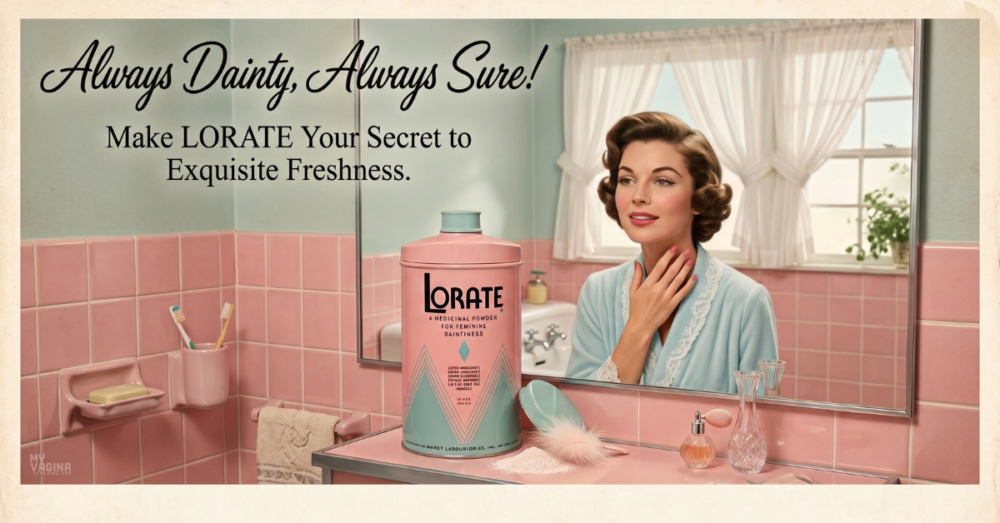

People douche because they have been told, over and over for more than a century, that their bodies are dirty and need cleaning out. They almost never do.
The vagina looks after its own cleaning, and flushing it out with water, vinegar, iodine or a fragranced ‘feminine wash’ can strip away the protective bacteria that keep it well. That’s exactly why douching is linked to bacterial vaginosis (BV) and pelvic inflammatory disease (PID).
So if it is bad for us, why do so many of us still do it? The reason is marketing. A shame-based ‘feminine hygiene’ industry spent a hundred years inventing a problem so it could sell you the cure. And it aimed that message squarely at the women it thought would be easiest to frighten.
This is the companion piece to our gallery of vintage douche ads, which are worth a look before or after you read this. Because once you know the playbook you cannot unsee it.
Why do women douche?
Mostly because someone taught them to, and that someone was usually either their mother or an advertisement, or both. When researchers ask women why they douche, the answers cluster around feeling clean, feeling fresh, washing after a period, washing after sex, and getting rid of odour. Underneath nearly all of those reasons sits the same belief: that a normal vagina is unclean and needs correcting.
It is a belief that did not come from biology. It came from a sales pitch, and it was handed down through families so faithfully that plenty of people now douche without ever questioning where the habit started.
Where did douching come from?
The modern douche has a tangled history that runs through antiseptics, illegal birth control and good old-fashioned shame. In the late nineteenth and early twentieth centuries, douching was promoted first as a general antiseptic and then, quietly, as contraception.
This is where Lysol comes in, and yes, the same Lysol that lives under your sink. From the 1930s to the 1960s, Lysol was the leading ‘feminine hygiene’ product in the United States, and ‘feminine hygiene’ was a coded phrase for birth control.1
Sending, advertising or selling contraception was restricted under the Comstock laws, so manufacturers dressed it up in euphemism. An advert could not say ‘use this so you do not fall pregnant’, but it could whisper about ‘germs’, ‘odour’ and keeping your ‘dainty feminine allure’, and women understood the real message.1–2
The trouble is that douching is a hopeless contraceptive, and the early formulas were dangerous. Lysol became the best-selling contraceptive product of the Great Depression despite being unreliable, and its early formula contained cresol, a phenol compound reported in some cases to cause inflammation, burning and even death.2
We have written more about the long, grim tradition of douching as a form of birth control, including the truly desperate Coca-Cola douche myth, neither of which you should ever rely on.
When the contraceptive pill arrived in 1960, women finally had a reliable and effective alternative, and the douche could have quietly retired. Instead the industry pivoted. The product stayed the same; only the reason to buy it changed, from ‘do not get pregnant’ to ‘do not be disgusting’. That is when ‘freshness’ and ‘daintiness’ took over the advertising completely.
Who is targeted by feminine hygiene marketing?
Women, overwhelmingly, and within that, the women the industry judged most anxious about being acceptable: young women worried about attracting or keeping a partner, and, very deliberately, Black women and other women of colour. We will come to the racial targeting on its own because it deserves proper attention.
The genius of the marketing, if you can call it that, was emotional. It did not argue that you had a medical problem. It planted a fear that you might, that you could be offensive without knowing it, that a husband might drift away over something you could not smell yourself. You cannot disprove a worry like that, so you keep buying the reassurance.
Manufacturing a problem to sell the solution
If you study the old adverts, the formula barely changes across the decades. Step one, invent insecurity: suggest the reader is harbouring an odour or ‘germs’ that everyone else can detect.
Step two, raise the stakes: tie that imagined flaw to losing love, losing a marriage, being whispered about. Step three, sell the rescue: position the product as the only thing standing between her and social ruin.
It worked because it ran on shame, and shame is a reliable engine. A product that solves a real problem has a ceiling, because once the problem is fixed you stop buying. A product that solves an imaginary problem can sell forever, because the problem never actually goes away. Nobody was ever going to wash themselves clean of a flaw they never had.
What the numbers actually show
Despite decades of doctors advising against it, douching held on. Surveys still find a substantial minority of United States women of reproductive age douche, on the order of one in five.3 The practice is far from evenly spread, though. It is more common with increasing age, with lower income, and with less formal education, and it varies a lot by background.3
In national survey data from 2001 to 2004, around 37 per cent of Black women reported douching in the previous month, compared with around 14 per cent of white women and 10 per cent of Mexican American women.4 These are not numbers to wag a finger at. They are a map of where a century of targeted advertising landed, and they tell a story about who was sold the hardest version of the shame.
The targeted marketing of douching to Black women
The higher rates of douching among Black women in the United States are not a cultural quirk and they are certainly not a failing. They are the predictable result of being marketed to, specifically and for generations, on top of a much older history.
The idea that Black women’s bodies were somehow unclean or in need of correction was used, historically, as a tool of control, long before anyone had a product to sell. The ‘feminine hygiene’ industry inherited that prejudice and monetised it, running advertising that leaned directly into odour anxiety and aimed it at Black consumers.5
When a message is repeated to a community for decades, and then passed from mother to daughter as ordinary self-care, it stops feeling like advertising and starts feeling like common sense.
There is a measurable cost beyond the habit itself. Fragranced douches and washes are a source of chemical exposure, and the disparity shows up in the body.
In an analysis of national survey data, Black women had higher urinary levels of a diethyl phthalate metabolite than white women. Adjusting for douching shrank that gap considerably, meaning a real chunk of the difference was explained by the products themselves.4
Women who douched two or more times a month had around 152 per cent higher concentrations of that metabolite than women who did not douche at all.4
So the same group sold the most douching also carries a heavier load of the chemicals that ride along with it. That is worth naming plainly, without a scrap of blame landing on the women involved, because the responsibility sits with the industry that built the campaign.
How douching affects your vagina
Here is the part the advertising got exactly backwards. A protective vagina is not a sterile one.
It runs on a living community of bacteria, ideally dominated by Lactobacillus species such as Lactobacillus crispatus, which keep the environment acidic and crowd out the disruptive bacteria that cause infections. You can see what that looks like in our guide to a protective vaginal microbiome.
Douching pours a wash straight through that ecosystem and flushes the good with the imagined bad. Strip out the lactobacilli and you lower the acidity, which is an open invitation to the anaerobic bacteria behind bacterial vaginosis.
The evidence here is solid. A careful longitudinal analysis that specifically set out to rule out reverse causation still found regular douching associated with developing BV.6
A broad review of the literature links douching with BV, pelvic inflammatory disease, ectopic pregnancy, low birth weight, preterm birth, cervical cancer and increased susceptibility to sexually transmitted infections.3
Newer survey work points the same way. A community study in Ghana found douching common among women, with nearly four in ten reporting abnormal vaginal discharge.7 The picture across the research is consistent: the product marketed to make you cleaner and healthier does the opposite where it counts.
That ironic twist is the whole tragedy of it. Odour is one of the main reasons people reach for a douche, but BV, which douching can contribute to, is itself one of the most common reasons for a strong vaginal odour. The ‘cure’ feeds the very thing it promises to fix.
Why the habit persists
A few things keep douching alive. It is an inherited habit, taught young and rarely re-examined.
The marketing has never really stopped, it just moved from douche bags to wipes, washes, sprays and ‘pH-balanced’ bottles lined up in the same aisle. And there is a layer of distrust, often well-earned, between some communities and a medical system that has not always treated them well.
There is also a real, unmet need hiding underneath the sales pitch. People who douche are frequently bothered by something genuine, usually odour or discharge, and they deserve a real answer rather than a fragranced cover-up.
The honest response is not to shame anyone for douching. It is to explain why it backfires and to point at what actually works.
People douche for all sorts of reasons. And in our clinical work we find many are reluctant to stop – they believe it matters, or they rely on it to keep symptoms at bay. Simply stopping is not the answer for everyone. Our role is to put safeguards in place so the move away from regular douching is graduated and supported. We explain what is actually going on, then either leave a healthy microbiome in peace or, where it needs work, treat it properly with someone overseeing it. So no one is left unsupported and stuck with symptoms.
A kinder, more accurate message
Your body is not dirty by default. The vulva on the outside needs nothing more than warm water and, if you like, a plain unfragranced wash on the skin only, never inside.
The vagina on the inside is best left entirely alone to do its own housekeeping. If you take one thing from a hundred years of advertising history, let it be that the inside of the vagina is not a surface to be scrubbed.
This is borne out when intimate hygiene practices and the vaginal microbiome are studied together. One recent study linked washing inside the vagina with recurrent yeast infections, while washing only the external skin showed no such link.8
From a whole-body, functional point of view, persistent odour is a signal worth investigating at the level of the microbiome, not masking at the level of perfume. If something really does smell off, that is information about the bacterial balance, and the fix is to support the ecosystem, not to wash it away.
If odour or discharge is bothering you, our piece on vaginal odours and what they mean is a far better starting point than the chemist’s shelf.
Frequently asked questions
Is douching ever necessary?
For everyday health, no. Protective vaginas clean themselves through normal discharge and a self-regulating bacterial balance.
The rare exceptions are specific medical situations directed by a clinician, such as a prescribed treatment for a diagnosed condition, and even those are increasingly uncommon. Routine douching for cleanliness or freshness is never necessary and carries real risk.
Why is douching more common in some communities?
Largely because of decades of targeted advertising layered on top of older prejudices, plus the way habits pass down through families. In United States data, Black women and lower-income women report higher rates, which reflects who the industry marketed to most aggressively rather than anything about the bodies involved.
Was Lysol really marketed as a douche?
Yes. From the 1930s to the 1960s, Lysol was the leading ‘feminine hygiene’ product in the United States and was advertised, in coded language, as a contraceptive douche. It was both ineffective as birth control and, in its early cresol-based formula, capable of causing real harm.
Does douching cause BV?
It is closely linked to it. Douching strips out the protective lactobacilli and lowers vaginal acidity, which lets the bacteria behind bacterial vaginosis take hold. Longitudinal research associates douching with developing BV, and stopping is one of the simplest changes you can make to lower your risk.
What should I use instead of douching?
For the vulva, warm water is plenty, with a mild unfragranced cleanser on the skin only if you prefer. Inside the vagina, use nothing at all. If you are dealing with ongoing odour, discharge or irritation, that is worth properly investigating rather than rinsing away, because it usually points to something treatable in the microbiome.
What to do next
If you have been douching, the kindest thing you can do for your vagina is simply stop, and give the microbiome a chance to rebalance. If symptoms such as odour, unusual discharge or irritation are what drove you to it in the first place, those deserve a real look rather than a cover-up.
A good next step is a comprehensive vaginal microbiome test, which shows what is actually growing rather than leaving you to guess. Our free guide to treating bacterial vaginosis is a sound place to start reading. And you are always welcome to book an appointment with one of our practitioners if you would like to get to the root of recurring symptoms.
This is general information, not a substitute for personalised medical advice.
- Hall K. Selling Sexual Certainty? Advertising Lysol as a Contraceptive in the United States and Canada, 1919–1939. Enterprise & Society. 2013;14(1):71–98.
- Eveleth R. Lysol’s Vintage Ads Subtly Pushed Women to Use Its Disinfectant as Birth Control. Smithsonian Magazine. 2013.
- Martino JL, Vermund SH. Vaginal douching: evidence for risks or benefits to women’s health. Epidemiol Rev. 2002;24(2):109–124.
- Branch F, Woodruff TJ, Mitro SD, Zota AR. Vaginal douching and racial/ethnic disparities in phthalates exposures among reproductive-aged women: National Health and Nutrition Examination Survey 2001–2004. Environ Health. 2015;14:57.
- Our Bodies Ourselves. The Racist Legacy of ‘Feminine Care’ Products. Our Bodies Ourselves Today.
- Brotman RM, Klebanoff MA, Nansel TR, et al. A longitudinal study of vaginal douching and bacterial vaginosis – a marginal structural modeling analysis. Am J Epidemiol. 2008;168(2):188–196.
- Wireko S, et al. Vaginal douching and health risks among young women. Health Sci Rep. 2024;7(2):e1882.
- Magoutas K, Holdcroft A, Walls M, Furfaro L, Ireland D, Payne MS. Investigating the link between intimate health, hygiene and sexual practices and the vaginal microbiome – the INTIMATE study. Reprod Med Biol. 2025;24(1):e12685.