

 Something else? Ask Aunt Vadge – bottom left of your screen!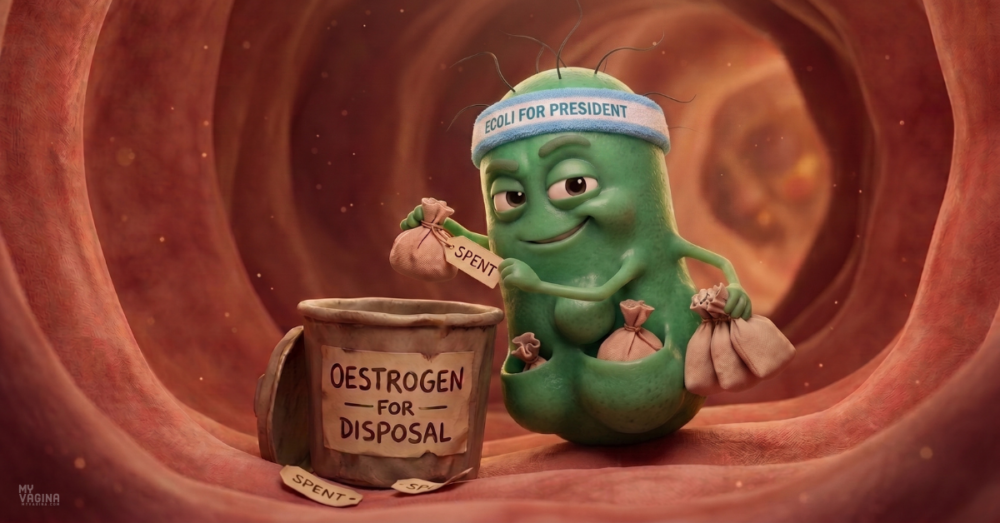

Your gut bacteria may do far more than digest your dinner. A new review in npj Biofilms and Microbiomes argues that the microbes living in and on you act as an active ‘endocrine partner’, helping to set how much oestrogen your body is exposed to, producing hormone-like molecules of their own, and shaping the inflammation and tissue conditions that matter in oestrogen-driven cancers such as oestrogen receptor-positive breast cancer and endometrial cancer.1
This is the idea of the ‘estrobolome’ grown up. The estrobolome is the set of gut bacteria that recycle oestrogen, and we have written about it before in what is the estrobolome. The new review pushes the concept wider, into a two-way endocrine-microbiome axis where hormones shape your microbes and your microbes shape your hormones.1
The authors are clear that this is a promising framework, not a finished therapy. Most of the human evidence shows associations rather than proven cause and effect, so for now they call it a high-priority research idea rather than something you can act on at the chemist.1
What is the estrobolome, in plain terms?
Your liver packages up oestrogen for disposal by attaching little chemical tags to it (a process called conjugation). This marks it as ‘spent’ and sends it out through the bile into the gut to leave the body.1,2
Certain gut bacteria carry enzymes, chiefly β-glucuronidase and sulfatases, that snip those tags back off. That reactivates the oestrogen, which can then be reabsorbed into circulation instead of being excreted. The practical upshot is that your gut bacteria help decide how long active oestrogen hangs around in your body.1,2
This matters because lifetime oestrogen exposure is one of the recognised drivers of hormone-dependent cancers. If your microbial mix leans towards reactivating more oestrogen, the theory goes, your tissues see more of it over time.1,2
What is new in this review?
The older ‘estrobolome 1.0’ picture was mostly about recycling, with bacteria as a sort of oestrogen reclamation depot. The new review, titled ‘Beyond estrobolome 1.0’, argues that view is too narrow.1
Instead, it frames the microbiome as an active endocrine partner. Gut microbes respond to your own hormonal signals, process what you eat into biologically active molecules, and influence metabolic, immune and tissue-level pathways well beyond the gut itself.1
That makes it a two-way street. Hormones shape which microbes thrive, and those microbes in turn modify hormone signalling, inflammation and metabolism. The review calls this the bidirectional endocrine-microbiome axis.1
How gut microbes change oestrogen activity
It is not as simple as ‘more bacteria, more oestrogen’. Besides β-glucuronidase, some bacterial enzymes reactivate oestrogen while others convert it into weaker forms. So the very same community can push oestrogen exposure up or down depending on its make-up, your diet, your medications and your health status.1
Gut microbes can also turn some plant compounds into hormone-like metabolites. The best-known example is S-equol, made when certain gut bacteria break down soy isoflavones. Unlike the body’s main oestrogen, oestradiol, S-equol preferentially binds oestrogen receptor beta, so it may nudge oestrogen signalling in a tissue-specific way.1
Other microbial products, such as the enterolignans made from dietary lignans, also influence oestrogen signalling. Not everyone carries the bacteria needed to make these compounds, which is part of why two people eating the same food can end up with very different hormonal effects.1
Hormones also shape your microbes
The traffic runs both ways. Hormonal shifts across puberty, pregnancy, menopause and hormone therapy change microbial metabolism, including bile acid, carbohydrate and steroid pathways. Those microbial changes then feed back into hormone availability and immune responses.1
Bacteria can even sense host hormone signals and adjust their own growth and behaviour accordingly. The review suggests that life stages marked by big hormonal change may be critical windows, when the microbiome has an outsized say in long-term hormone exposure and disease risk.1
The endocrine-microbiome axis in cancer
When this axis is disrupted, the review describes several ways it might tip towards cancer. Microbial imbalance (dysbiosis) is linked to chronic low-grade inflammation and greater exposure to microbial molecules that switch on inflammatory pathways. That inflammatory state can also disturb insulin and metabolic signalling, which may work alongside oestrogen to push tumour growth.1
There is also a local angle. Breast, uterine and endometrial tissues appear to host their own distinct microbial communities, which may influence local oestrogen metabolism, immune activity and inflammation without changing the hormone levels in your blood.1
Some microbial products can damage DNA or alter gene regulation through epigenetic changes, while others make short-chain fatty acids that affect how genes are switched on and off. Taken together, these local and whole-body effects could contribute to hormone-driven cancer, though the human evidence is still largely observational.1,3
How this affects the vagina and vulvovaginal health
This is a gut-and-hormones story, but it lands squarely on vulvovaginal health, because the vagina is an oestrogen-sensitive organ. Oestrogen feeds the vaginal lining with glycogen, which the protective bacteria (the lactobacilli) use as fuel to make lactic acid and keep the vagina acidic and resilient.
If the gut and its enzymes help set how much active oestrogen your tissues see, then the gut also has a hand in the conditions your vaginal microbiome has to work in. Too little oestrogen and the lining thins, glycogen drops, lactobacilli struggle, and pH drifts up, which is the kind of terrain where bacterial vaginosis (BV) and recurrent yeast infections get a foothold.
The reverse matters too. Relative oestrogen excess is part of the picture in several conditions we see, including polycystic ovarian syndrome (PCOS) and the spectrum of oestrogen-driven gynaecological problems. A gut that recycles more oestrogen is one more lever in how those conditions play out.
In our clinical work, we meet people whose digestive complaints and skewed hormones turn out to be tangled together. We treat them as a whole, sorting the gut so the secondary hormone problems the estrobolome is feeding have a chance to settle. This review is a useful reminder of why treating the gut and hormones together makes physiological sense.
Could this become a treatment one day?
The microbiome may also affect how well hormone treatments work. Gut bacterial activity can influence the levels of tamoxifen metabolites, including endoxifen (its main active form), and aromatase inhibitors may in turn shift the make-up of the gut microbiota. That hints at a future where microbiome status helps tailor endocrine therapy, but the clinical evidence is not there yet.1
Researchers are exploring microbiome-targeted tools such as probiotics, prebiotics, selective enzyme inhibitors, defined microbial consortia, live biotherapeutic products (essentially pharmaceutical-grade probiotics) and faecal microbiota transplantation (FMT). Early laboratory work suggests these can dial down harmful microbial enzyme activity or boost helpful hormone-like metabolites.1
The honest caveat is that most of this evidence comes from lab and biomarker studies, not trials measuring actual cancer outcomes. FMT also carries safety, donor-selection and standardisation challenges, which is why the authors favour defined consortia and live biotherapeutics as safer, more controllable options, all still needing proper clinical testing.1
What the researchers say is still missing
The big limitation is that most human studies show associations, not cause and effect. Differences in diet, medications, menopausal status, geography and lab methods make studies hard to compare, so it is difficult to say what the microbiome is doing versus what it merely sits alongside.1
To move forward, the authors call for longitudinal studies with standardised methods, multi-omic approaches, multi-kingdom profiling that includes the virome and mycobiome (viruses and fungi, not just bacteria), and sex-stratified analyses. Until that work is done, they frame the endocrine-microbiome axis as a high-priority translational hypothesis, not a validated clinical target.1
Frequently asked questions
Does this mean my gut bacteria can cause breast or endometrial cancer?
No, not on this evidence. The review describes plausible mechanisms and consistent associations, but it does not show that gut bacteria cause these cancers in humans. Lifetime oestrogen exposure, genetics and many other factors all play a part.1
Should I take a probiotic to lower my cancer risk?
There is no good evidence yet that any probiotic lowers oestrogen-driven cancer risk. The microbiome-targeted strategies in the review are research tools at this stage, not proven prevention. A varied, fibre-rich diet supports a diverse microbiome generally, which is sensible regardless.1
What is S-equol and do I make it?
S-equol is a hormone-like compound your gut bacteria can make from soy isoflavones, but only if you carry the right bacteria. Whether you are an ‘equol producer’ depends on your microbiome, which is one reason soy seems to affect people so differently.1
How does the gut connect to my vaginal health?
The gut helps set how much active oestrogen your body sees, and oestrogen feeds the vaginal lining and the protective lactobacilli that keep it acidic. When oestrogen or the gut is out of balance, the vaginal environment can shift in ways that favour BV and recurrent yeast.1
Does menopause change this?
Yes. Hormonal shifts at menopause change microbial metabolism, and the falling oestrogen also thins vaginal tissue. The review suggests hormonal turning points like menopause may be especially important windows in the gut-hormone relationship.1
Can a microbiome test tell me my cancer risk?
Not for this. No test on the market translates your microbiome into an oestrogen-driven cancer risk score, and the science is not at that point. Testing can still be genuinely useful for working out what is happening with vaginal symptoms.
What to do next
This is early-stage science, so the sensible response is interest, not alarm. There is no estrobolome pill to buy and no microbiome test that reads your cancer risk. The strongest takeaway is that gut health, hormones and vulvovaginal health are genuinely connected, which fits what we see in practice.
If you have ongoing vaginal symptoms, recurrent BV or yeast, or hormone-driven concerns, a clear picture of your vaginal bacteria is a good place to start. You can read how to get a comprehensive vaginal microbiome test, learn more about hormones and the menstrual cycle, or book an appointment to work through the gut-hormone picture together.
For anything that needs a physical or internal examination, such as breast or pelvic assessment, see your GP or specialist. We are a naturopathic clinic and do not perform physical exams ourselves, but we work well alongside that care.
This is general information, not a substitute for personalised medical advice.
- Mou E, Guo R, Yi Y, Li Y, Yao Y, Xu J. Beyond estrobolome 1.0: unraveling endocrine-microbiome axis as a driver and therapeutic target in hormone-driven cancers. npj Biofilms Microbiomes. 2026 (in press). doi:10.1038/s41522-026-01074-9.
- Larnder AH, Manges AR, Murphy RA. The estrobolome: estrogen-metabolizing pathways of the gut microbiome and their relation to breast cancer. Int J Cancer. 2025;157(4):599–613. doi:10.1002/ijc.35427.
- Kumar Malesu V. Gut microbes emerge as potential players in estrogen-driven cancers. News-Medical. 25 June 2026.