

 Something else? Ask Aunt Vadge – bottom left of your screen!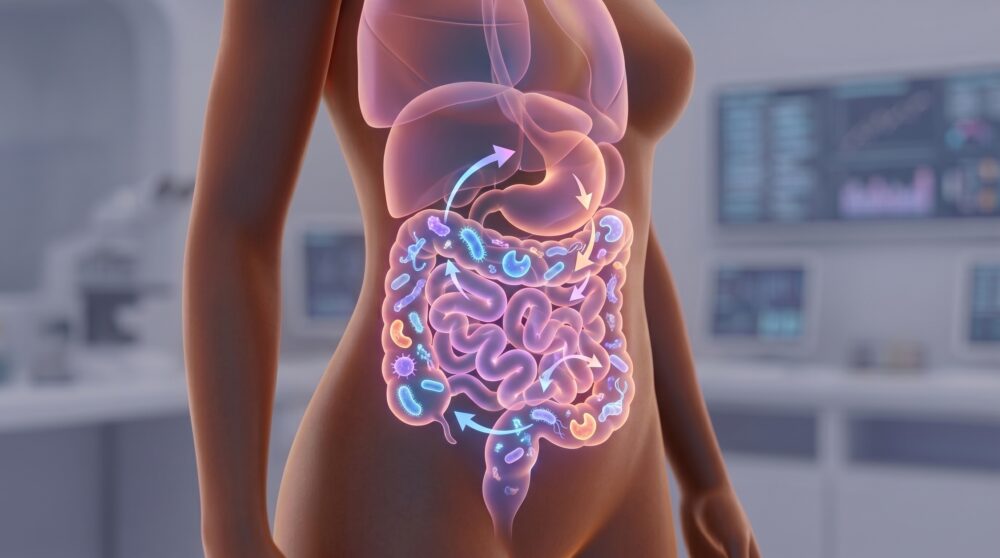

The estrobolome is the collection of gut bacteria – and their genes – that help control how much oestrogen circulates in your body. It is one of the clearest examples of your gut microbiome reaching well beyond digestion to shape your hormones, your periods, your fertility and even your vaginal health.1
The term was coined in 2011 to describe the aggregate of gut microbial genes capable of metabolising oestrogens.2 Since then it has become a useful way to talk about the two-way relationship between your gut and your hormones.
What is the estrobolome, exactly?
Your liver packages used oestrogen up for disposal by attaching a molecule to it (a process called conjugation) and sending it to the gut. On its own, that oestrogen would simply leave the body in stool.
But certain gut bacteria produce an enzyme called beta-glucuronidase (β-glucuronidase), which snips that disposal tag back off – reactivating the oestrogen so it can be reabsorbed into the bloodstream. The estrobolome is, in effect, the part of your microbiome that decides how much oestrogen gets recycled rather than excreted.1
How the estrobolome controls your oestrogen levels
When your gut microbiome is diverse and balanced, β-glucuronidase activity sits in a healthy range and oestrogen recycling stays steady.
When the microbiome is disrupted – what is known as dysbiosis – this balance tips. Lower microbial diversity tends to mean less β-glucuronidase activity, so less oestrogen is reactivated and circulating oestrogen falls. That drop has been linked with hypo-oestrogenic conditions such as metabolic syndrome and cardiovascular risk.1
In the other direction, an estrobolome that reactivates too much oestrogen can contribute to a state of relative oestrogen excess – often called oestrogen dominance – which is relevant to oestrogen-driven conditions.2
Why the estrobolome matters for conditions you have heard of
Because oestrogen shapes so much of female physiology, an estrobolome that is pushing oestrogen too high or too low has been connected to a long list of conditions, including endometriosis, polycystic ovary syndrome (PCOS), oestrogen-sensitive cancers, and the symptoms of perimenopause and menopause.1
The estrobolome is one piece of a much bigger puzzle rather than the single cause of any of these. But it helps explain why gut health keeps turning up in conversations about hormonal conditions.
Conditions you may not have heard of
Not every influence on the estrobolome comes from a familiar gynaecological diagnosis. Some sit in your genes and your liver, quietly shaping how oestrogen is processed before the gut is ever involved.
Gilbert’s syndrome and the estrobolome
The clearest example is Gilbert’s syndrome. It is one of the most common inherited variations there is – present in somewhere between 3 and 10 per cent of people3 – and is caused by reduced activity of a liver enzyme called UGT1A1 (UDP-glucuronosyltransferase 1A1).4
Most people know it, if they know it at all, as the reason for mildly raised bilirubin and the occasional bout of unexplained jaundice during illness, fasting or stress.
The connection to the estrobolome lies in what UGT1A1 actually does. It is one of the enzymes responsible for glucuronidation. This is the tagging-for-disposal step described above, where the liver attaches a molecule to used oestrogen so it can be sent to the gut and excreted. UGT1A1 helps conjugate oestradiol, your main oestrogen, in particular.
In Gilbert’s syndrome that conjugation machinery runs slower than usual, so – at least in theory – oestrogen may be cleared a little less efficiently and linger in its active form for longer.5
So while the estrobolome governs the downstream step – how much oestrogen your gut bacteria reactivate – Gilbert’s syndrome affects the upstream step, how efficiently oestrogen is packaged for disposal in the first place. The two sit on the same recycling loop, one at each end.
Other less common conditions & genes impacting the estrobolome
Gilbert’s is not the only inherited quirk that nudges this system. A handful of others affect the same broad set of oestrogen-processing enzymes:
- Crigler-Najjar syndrome – a much rarer and more serious condition at the severe end of the same UGT1A1 spectrum, where glucuronidation is profoundly reduced rather than just a little slow.5
- Slow COMT gene – an inherited variation in catechol-O-methyltransferase, the enzyme that clears the more reactive oestrogen breakdown products by methylating them. Lower activity means these metabolites are cleared more slowly.6
- Lower SULT1E1 gene activity – sulphation is a second major off-switch for oestrogen, run by the enzyme SULT1E1. Reduced activity leaves less oestrogen inactivated by this route.7
The gut end of the loop has its own influences that owe nothing to genetics: a course of antibiotics, broader dysbiosis, or sluggish bowel transit can all change how much oestrogen your β-glucuronidase-producing bacteria reactivate. This is exactly why the gut-supporting measures below matter.
A note of caution: most of this is mechanistically logical rather than firmly proven. The biochemistry – which enzymes act on oestrogen, and that Gilbert’s reduces UGT1A1 – is well established. The downstream effect on circulating oestrogen, vaginal health or oestrogen-driven conditions in any one person is likely to be modest, is still being researched, and the human evidence so far is mixed.5
It’s best thought of as one more reason your oestrogen balance is set by your liver enzymes and your gut bacteria working together, rather than a diagnosis to chase.
The estrobolome and your vaginal health
Here at My Vagina, we see people whose digestive complaints and skewed hormones often turn up together. Rather than chasing each symptom as a separate diagnosis, we treat the whole person. That might mean settling the gut and digestion first, and seeing what clears up as a result. It’s amazing how often correcting the diet, nutrients and absorption can clear up a number of niggling problems. We look upstream of the symptoms, because that’s where we find so many of our answers – in the most unexpected of places!
This is where it gets interesting for us. Oestrogen is what drives your vaginal cells to produce glycogen, and glycogen is the fuel that protective Lactobacillus bacteria feed on. Strong oestrogen support means a well-fed, Lactobacillus-dominant vaginal microbiome; low oestrogen means less glycogen and a more vulnerable vaginal environment.1
An abundance of oestrogen – often referred to as ‘relative oestrogen excess’ (relative to progesterone) – can also come with its own issues, so there is a limit to how much is enough. Yeast, for example, can thrive in a high oestrogen environment.8
But, if your estrobolome is dragging your circulating oestrogen down, the knock-on effects can show up as vaginal dryness, irritation, and a greater tendency towards bacterial vaginosis (BV) and other forms of dysbiosis.1 Gut health and vaginal health are more connected than they look.
How to support a healthy estrobolome
The estrobolome responds to the same things that support gut health generally:
- Eat a wide variety of plants and plenty of fibre to feed a diverse microbiome
- Look after gut diversity – limit unnecessary medications and ultra-processed food
- Include fermented foods and phyto-oestrogen-containing foods where they suit you
- Include cruciferous vegetables – broccoli, cauliflower, cabbage and Brussels sprouts – which support oestrogen metabolism
- Address constipation and sluggish bowel transit, which affect oestrogen clearance – aim for at least one bowel movement per day
There is no single supplement that ‘fixes’ the estrobolome – it is an ecosystem effect, built over time through diet, lifestyle and overall gut health.1
Frequently asked questions
Is the estrobolome in the gut or the vagina?
The estrobolome refers specifically to oestrogen-metabolising bacteria in the gut. But because gut bacteria help set your circulating oestrogen levels, and oestrogen shapes the vaginal environment, the gut estrobolome indirectly influences vaginal health.
Can I test my estrobolome?
Not directly as a routine clinical test yet. Some functional stool tests report beta-glucuronidase activity as a rough proxy for estrobolome function, but they need a practitioner to order and interpret. And sample handling makes the readings less reliable than they look. There is no simple, validated ‘estrobolome score’ in everyday practice.
The most useful lever for now is supporting a diverse gut microbiome, which might look different for each of you, depending on your genetics, environment and tolerances.
Does the estrobolome change at menopause?
Oestrogen falls dramatically at menopause regardless of the gut, but the estrobolome still influences how much of the oestrogen that remains is recycled. Gut diversity also tends to shift with age, which is one more reason gut health matters through the menopausal transition.
Getting support
If you feel like your gut is related to your vaginal symptoms, or you’re just curious to see if there’s a link, book a consultation with one of our naturopaths for a thorough assessment. If need be, your practitioner will develop a unique treatment plan just for you, to get you feeling better faster.
This is general information, not a substitute for personalised medical advice. If you have symptoms or concerns, please see your own practitioner.
- Baker JM, Al-Nakkash L, Herbst-Kralovetz MM. Estrogen–gut microbiome axis: physiological and clinical implications. Maturitas. 2017;103:45–53.
- Plottel CS, Blaser MJ. Microbiome and malignancy. Cell Host & Microbe. 2011;10(4):324–335.
- Vítek L, Tiribelli C. Gilbert’s syndrome revisited. J Hepatol. 2023;79(4):1049–1055.
- Bosma PJ, Chowdhury JR, Bakker C, et al. The genetic basis of the reduced expression of bilirubin UDP-glucuronosyltransferase 1 in Gilbert’s syndrome. N Engl J Med. 1995;333:1171–1175.
- Novel insights into UDP-glucuronosyltransferase 1A1 dysfunction and Gilbert’s syndrome on estrogen metabolism and breast cancer. Crit Rev Oncol Hematol. 2026.
- Dawling S, Roodi N, Mernaugh RL, Wang X, Parl FF. Catechol-O-methyltransferase (COMT)-mediated metabolism of catechol estrogens: comparison of wild-type and variant COMT isoforms. Cancer Res. 2001;61:6716–6722.
- Yi M, Negishi M, Lee SJ. Estrogen sulfotransferase (SULT1E1): its molecular regulation, polymorphisms, and clinical perspectives. J Pers Med. 2021;11(3):194.
- Kumwenda P, et al. Estrogen promotes innate immune evasion of Candida albicans through inactivation of the alternative complement system. Cell Rep. 2022;38(1):110183.