

Vaginal Health

Welcome to a comprehensive resource dedicated to supporting your understanding of vaginal, pelvic, and reproductive health.

Here, you’ll find essential information on topics ranging from menstrual cycles and hormonal changes to managing vaginal infections and understanding how pregnancy affects your vulva and vagina.

You’ll get clear, reliable knowledge to help you navigate your health with confidence.

Whether you’re seeking to deepen your understanding of changes of life stage or facing more complex health concerns, My Vagina is here to support you. 
Understanding vaginal tastes (the good and the bad)

A comprehensive overview of how different elements like diet, hygiene, and natural body secretions impact the taste of a vagina.

What to do if you have unprotected sex and may be or are pregnant

We run through your basic options for what to do if you think you might be pregnant.
Aunt Vadge’s Treatment Chooser

Not sure which direction to go in? Our treatment chooser can help!

Infections

Several common vaginal infections affect millions of women all over the world every day, with bacterial vaginosis (BV) and yeast infections being the most frequent. But, don’t forget aerobic vaginitis (AV) and urinary tract infections (UTIs)

Why does my vagina smell bad? 

Bacterial vaginosis (BV) occurs when the balance of bacteria in the vagina is disrupted, leading to an overgrowth of disruptive bacteria.

Symptoms of BV can include a thin, greyish discharge with a fishy odour, particularly noticeable after sex and your period. But, some people experience no symptoms at all.

Aerobic vaginitis (AV) can also cause a foul odour, but it’s different to BV. See your doctor and get tested, or do an at-home comprehensive vaginal microbiome test. Send us the results and we’ll help you! Free! 

Why is my vagina itchy? 

Yeast infections, caused by an overgrowth of the fungus Candida albicans and related species, are another common issue, which may be recurrent.

Yeast infections can lead to symptoms like intense itching, burning, swelling, and a thick, white discharge that resembles cottage cheese. But, it usually doesn’t smell bad. 

Yeast infections can be triggered by hormonal changes, antibiotic use, diet changes, or wearing moisture-trapping clothing or a wet bathing suit. 

Do I have an STI?

Sexually transmitted infections are common – is it chlaymdia, trich, gonorrhoea, HPV, and herpes. HIV and syphilis are also unfortunately on the rise in women. 

STIs need to be tested for and treated, so see your doctor for the best  testing or find an at-home provider who does STI testing. 

Getting help with infections

Here you’ll find what you need to know about how to treat issues effectively and what your options are, with lots of effective non-drug treatments for the most common issues, shipped internationally – free. And, we help you – free! 

See an experienced naturopath and get a fresh perspective

We also provide access to the world’s very best vulvovaginal specialist naturopaths, who work 100% holistically, anywhere in the world via telehealth.

Get the care you need, with drug-free natural treatments that work. We ship free globally. Book today. 

Single vs multi-strain L. crispatus: two BV trials

Two 2026 trials test L. crispatus probiotics for BV – one mapping who responds to a single strain, the other a new multi-strain approach.

Cervix-on-a-chip shows how protective bacteria block STIs

An immune-capable 'cervix-on-a-chip' lets scientists watch protective L. crispatus shield against STIs in real time, confirming the microbiome shapes risk.

Can cranberry treat bacterial vaginosis?

Discover how high-PAC cranberry supports vaginal wellness by reducing UTI-related BV flare-ups — not by curing BV, but by breaking the cycle.

HORMONES

Your body relies on a finely tuned balance of hormones to regulate your menstrual cycle, mood, energy levels, and overall health.

The primary hormones involved in reproductive health are estrogen, progesterone, and luteinising hormone (LH) and follicle-stimulating hormone (FSH).

Estrogen is crucial for developing and maintaining the reproductive system, thickening the uterine lining each cycle in preparation for pregnancy, whether you want it or not, and supporting vaginal health. Estrogen is also essential for bone, skin, and cardiovascular health.

Progesterone, produced after ovulation, stabilises the uterine lining and acts as a sedative and anti-anxiety, and also has an impact on vaginal tissue and the pelvic floor. Progesterone also helps the body prepare for pregnancy.

LH and FSH, produced by the pituitary gland, play key roles in ovulation by stimulating the ovaries to release a mature egg.

Testosterone is important for mood, energy, and also plays an important role in vaginal tissue health. 

Hormonal issues can arise in our premenopausal years, including:

Then, in your early 40s, perimenopause starts, where progesterone starts to decline. Then you stop getting periods altogether, at menopause, and become postmenopausal

What is the estrobolome?

The estrobolome is the set of gut bacteria that control how much oestrogen circulates – and it shapes your periods, fertility and vaginal health.

PCOS finally renamed, now PMOS

Polycystic ovary syndrome has a new name – polyendocrine metabolic ovarian syndrome (PMOS). Here's why it changed and what it means for you.

Vaginal bromocriptine for adenomyosis: a pilot trial

A small trial of vaginal bromocriptine eased period pain and heavy bleeding in adenomyosis – a rare non-contraceptive lead for an under-served condition.

SEX AND SEXUALITY

Understanding and treating keratin pearls

Keratin pearls, tiny irritants formed by keratin and squamous cells, can cause significant clitoral pain.

What happens to your body and brain when you orgasm

Embark on a fascinating journey through the hidden world of orgasms. Unveil the secrets of your brain's response to sexual pleasure.

Study: How doctors differ in screening for female sexual dysfunction

Researchers examined how FSD is addressed and investigated in routine healthcare check-ups in the USA.

PERIODS AND THE MENSTRUAL CYCLE

OTC period pain treatments

Discover effective ways to manage menstrual pain, from mild to severe, with evidence-based treatments, natural options, and self-care tips.

How to get hormone and blood testing

Learn how to get hormone testing on the right day for the most useful results, and what to do with the results.

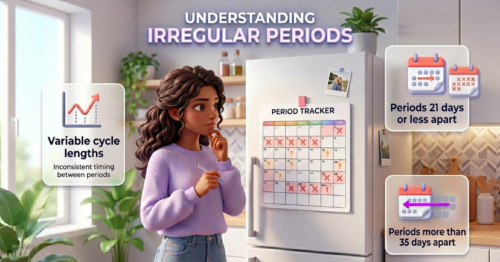
Understanding light or irregular periods (oligomenorrhoea)

Irregular periods are a cause for pause, as they indicate that a healthy menstrual cycle is not occurring when it should be.

The impact of PREGNANCY, CHILDBIRTH AND POST-BIRTH

What is lochia? Understanding post-birth vaginal discharge

Lochia is the natural post-birth vaginal discharge, comprising mucous, blood, and uterine tissue.

What to do if you have unprotected sex and may be or are pregnant

We run through your basic options for what to do if you think you might be pregnant.
Aunt Vadge’s Treatment Chooser

Not sure which direction to go in? Our treatment chooser can help!

Pelvic CANCERs

BV and ovarian cancer – is there a link?

Can an unhealthy vaginal microbiome contribute to or cause ovarian cancer? Researchers look into it.

In utero exposure to DES

DES is a synthetic oestrogen given to millions of women during the 50s and 60s, before it was found to possibly cause vaginal cancers in female offspring.

Study: Long-term overweight at greater risk of endometrial cancer postmenopause

A study looks at how long women were overweight or obese for, and their risk of certain cancers.

ANATOMICAL ABNORMALITIES

Vaginal adenosis

Vaginal adenosis is where cervical and endometrial cells are found in the vaginal walls, and is most related to women exposed to DES in the womb.

In utero exposure to DES

DES is a synthetic oestrogen given to millions of women during the 50s and 60s, before it was found to possibly cause vaginal cancers in female offspring.

46,XX testicular difference of sexual development (DSD)

Folks with the 46,XX testicular difference of sexual development (DSD) are genetically female, but look (and feel) like males in every other way.